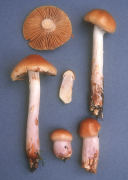
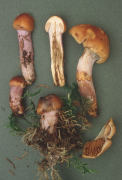
Cortinarius (Myxacium) collinitus (Sow. ex Fr.) Fr. s. Lange
Blaustieliger Schleimfuss Cortinaire à bracelets Cap 2–10cm across, convex then expanded with a low broad umbo, yellow-brown to tawny or dark rust, often darker at centre, glutinous drying shiny, margin incurved at first, sometimes slightly grooved. Stem 50–120´7–20mm, apex white to bluish, concolorous with cap below cortinal zone and covered in bluish bands of velar remains. Flesh whitish to yellowish, sometimes tinged bluish in stem apex. Taste mild, smell none. Gills pale violaceous or clay at first, later rusty. Spore print rust. Spores elliptic to almond- or lemon-shaped, rough, 12–20 x 7–9µ. Habitat conifer woods, more rarely deciduous. Season late summer. Occasional. Edibility unknown –avoid, many Cortinarius contain toxins –avoid, many Cortinarius contain toxins. Distribution, America and Europe. |